 09
09 Explore how generative AI is transforming static images into video, with insights into personalization, consistency, privacy, consent, and future trends.
Artificial intelligence has already changed the way digital images are created. What started with experimental text prompts and occasionally strange-looking results has developed into tools capable of producing surprisingly detailed characters, scenes and visual styles.
Adult entertainment has been part of that shift from the beginning. But the more interesting development now isn't simply better AI-generated images. It's a movement.
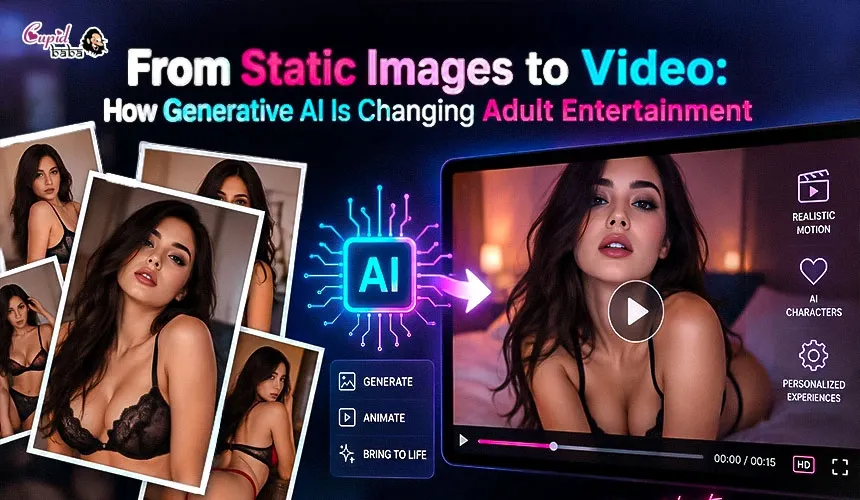
Generative AI is increasingly turning static pictures into short videos, allowing an existing character or image to become the starting point for an animated scene. Alongside text-to-video technology, this is beginning to create a new category of adult content that sits somewhere between traditional video production, digital art and interactive creation.
It is still an imperfect technology. But the transition from generating an image to generating a moving sequence may prove more significant than it initially appears.
Traditional online adult entertainment is fundamentally based on discovery.
Someone visits a website, searches for something that interests them, browses the available material and chooses what to watch. Recommendation algorithms have made that process increasingly personalized, but the content itself was still created beforehand.
Generative AI changes the order.
Instead of asking, "What content can I find?", a user can increasingly start with, "What do I want to create?"
That distinction explains much of the interest surrounding adult generative AI.
An AI porn video generator can give adults the ability to experiment with fictional characters, visual styles and generated scenes rather than relying entirely on a pre-existing content library. The experience becomes more creative and iterative: generate something, see the result, adjust the input and try again.
Video adds another dimension to that process.
A still image can establish what a fictional character or scene looks like. Video has to preserve that appearance while introducing movement, timing and continuity.
And that is considerably harder.
A convincing AI-generated image only needs to work once.
Video needs to work frame after frame.
If a character's appearance changes noticeably between frames, the illusion breaks. The same happens when clothing, backgrounds, lighting or body proportions unexpectedly shift as the sequence progresses.
This is one of the central technical problems facing generative video.
A model isn't simply being asked to produce a series of attractive individual images. Those images need to make sense together.
That requires what is often called temporal consistency.
Imagine generating a character wearing a particular outfit in a particular room. A still-image model can produce a single successful interpretation and stop there. A video model needs to understand what should remain consistent as the character moves and what should naturally change.
Hair needs to move without suddenly changing length. Facial features should remain recognizable. Objects should stay where they belong. Lighting should remain believable as the scene progresses.
Small errors that might go unnoticed in one generated image can become much more obvious when viewed as moving footage.
This is why AI videos are not simply "AI images, but more of them."
It is a different technical problem.
Two approaches are becoming particularly important: text-to-video and image-to-video.
With text-to-video, the user describes the desired scene and the model attempts to create both its visual appearance and movement.
This provides a lot of creative freedom, but it also gives the AI more decisions to make. The model has to determine what the character looks like, what the environment looks like and how everything should move.
Image-to-video starts from a different place.
The user already has the visual starting point.
With NSFW Image to Video, an existing eligible image can act as the reference for a generated sequence. Rather than inventing every visual element from scratch, the system has a source image showing the character, composition and general appearance it should attempt to preserve.
This can make image-to-video particularly useful when someone has already created a fictional AI character they like.
Neither method is inherently better. They simply offer different kinds of control.
Text-to-video is useful when the idea comes first.
Image-to-video is useful when the visual starting point already exists.
Increasingly, the most interesting generative platforms are likely to blur the distinction between the two.
One lesson that becomes obvious when experimenting with image-to-video is that the quality of the starting image matters.
AI cannot reliably recover information that simply isn't there.
A clear image with a well-defined subject usually gives a video model more useful information than a heavily compressed, blurry or strangely cropped source.
Composition matters too.
If important parts of the subject are outside the frame, the model may have to guess what they should look like when movement brings them into view. Those guesses can create inconsistencies.
Complicated backgrounds can introduce similar problems. When many objects overlap or the visual perspective is ambiguous, the model has more relationships to maintain throughout the sequence.
This means getting a better AI video often begins before the video is generated.
Choosing—or creating—a strong source image is part of the workflow.
That also explains why image generation, image editing and video generation are beginning to feel less like separate technologies. They increasingly form different stages of the same creative process.
A user might generate a character, refine the image, correct something they dislike and only then animate the final version.
It is tempting to judge generative adult video entirely on whether it can reproduce traditional adult entertainment.
That may miss the more important point.
The technology doesn't necessarily need to replace conventional video production to establish its own audience.
Its distinguishing feature is personalization.
Traditional adult studios and independent creators produce finished content for an audience. Generative systems can instead allow an individual user to influence the result.
That creates a fundamentally different relationship with the content.
A generated result can be changed and regenerated. Different visual styles can be explored. Fictional characters can be reused. An image that works particularly well can become the foundation for additional variations.
The user is therefore moving slightly closer to the role of creator.
This is similar to what happened with other forms of generative media. AI writing tools did not eliminate professional writers, and image generators did not eliminate photographers or illustrators. Instead, they introduced another way to produce and experiment with digital media.
Adult AI is likely to develop in a similar direction.
Despite the rapid improvement in generative video, current systems have weaknesses that are difficult to hide.
Longer sequences remain challenging because every additional moment gives the model another opportunity to lose consistency.
Complex movement is harder than subtle movement. Multiple subjects can be more difficult to maintain than one. Hands, overlapping objects, rapid changes in position and unusual camera perspectives can all expose weaknesses in the generation.
There is also an element of unpredictability.
Using the same source image twice does not necessarily produce identical results. For creative experimentation, that randomness can be interesting. For someone trying to achieve a very specific outcome, it can be frustrating.
Generation time and computing requirements matter as well. Producing a video requires substantially more processing than creating a single image.
The technology is improving, but it is important to distinguish what generative video can reliably do today from what polished demonstrations suggest it might eventually do.
Adult generative AI also brings responsibilities that cannot be treated as an afterthought.
The ability to transform images creates an obvious distinction between generating fictional adult characters and manipulating the likeness of a real person without permission.
That distinction matters.
Adults using generative tools should have the rights and consent necessary for any real-person source material they upload. Platforms also have a responsibility to establish safeguards against non-consensual imagery, minors and other prohibited material.
As generation becomes more realistic, these protections become more important, not less.
Responsible development therefore isn't separate from technological progress. It is part of whether this category can mature into a sustainable form of digital entertainment.
Privacy deserves similar attention. Users should understand what happens to uploaded images, how generated content is handled and what controls a service provides over personal data.
These questions are especially important for adult platforms because the material involved can be highly sensitive.
The obvious improvements are already visible.
Videos will become longer. Character consistency will improve. Movement will become more controllable. Generation should become faster, and users will likely gain more precise ways to specify what should—and should not—change within a scene.
But the bigger development may be the convergence of different AI tools.
Instead of using one product to create an image, another to edit it and another to animate it, these capabilities are increasingly likely to exist within connected workflows.
A fictional character could be generated from text, refined through image editing, animated through image-to-video and then reused across additional creations.
That is when generative adult content begins to look less like a novelty and more like its own medium.
AI-generated video still has plenty of rough edges. Motion can fail. Characters can change unexpectedly. Longer scenes remain difficult, and good source material still makes a noticeable difference.
But focusing only on those shortcomings overlooks how quickly the underlying workflow is changing.
Adult entertainment has traditionally been something produced by studios or creators and then consumed by viewers. Generative AI introduces another possibility: content that begins with the viewer's own idea and is created on demand.
Image-to-video pushes that idea further by giving existing fictional characters and images movement.
Whether it eventually becomes a major part of the adult industry will depend on more than visual quality. Privacy, consent, usability, affordability and responsible platform policies will all influence what happens next.
What is already clear is that generative adult content is moving beyond the static image.
The next challenge is making those images move convincingly—and responsibly.


You must be 21 years of age or older to enter